| This is a comparison of a 5,000 and 10,000 watt portable generator compared to a 12,000 watt Onan Residential Standby generator. We used our experience and costs based on Santa Rosa, CA. Not all areas of the country will be the same or have the same conditions. Cost is only one factor. Carefully consider the safety, security, setup and storage issues shown on the chart. Please read the summary at the end of this chart too! Whether you agree or now we want you to be informed. No matter what you decide to purchase we would like to have your order. We have residential generators from 8,000 watts (8 kW) to 45,000 watts (45 kW), in propane, natural gas and diesel. We have portable generators from 1,000 watts (1 kW) to 15,000 watts (15 kW) in gasoline, diesel, propane and natural gas. The majority of portable generators are gasoline powered. We will be offering portable kits which include a generator, transfer switch, cord and outlet box for one low price. If you are considering a portable for an RV use, see our chart at
Portable vs RV. For more information about fuels see
Generator Fuels.
COMPARISON OF CATEGORIES BETWEEN PORTABLE AND STATIONARY GENERATORS FOR HOME STANDBY USE
| | Category | Typical | Portable | Stationary | Winner |
| |
|
6,000 Watts |
12,000 Watts |
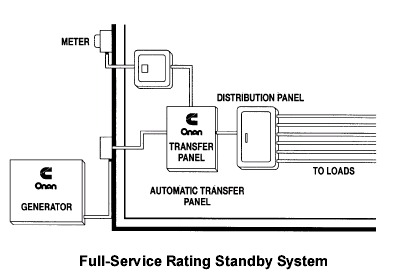
Stationary | | Models | Portable vs Residential | Winco WC6000HE | Onan RS12000 | Onan RS12000 | | Time of Need | Usually at night, bad weather | Must be protected from rain. | In protected cabinet. | Stationary | | Powers | % of House | 50% | 100% | Stationary | | Largest Single Load | Due to plug restrictions | 20 Amps | 100 Amps | Stationary | | Remote Control/Start | Automatic Preferred | No Auto-start | Auto-start Standard | Stationary | | Auto Choking | Automatic Preferred | No Auto-choke | Auto-Choke Standard | Stationary | | Move In/Out | Permanent Desirable | Required unless shelter | Move not required | Stationary | | Setup or Connecting | Permanent Desirable | Required unless shelter | Always Connected | Stationary | | Transfer of Power | Automatic Preferred | Manual Only | Automatic | Stationary. Automatic | | Unattended Operation | Unattended desirable | Short Periods Only | Runs Unattended | Stationary | | Operation by Family | Desirable | Usually difficult | Automatic Operation | Stationary | | Weather Protection | Desirable | Requires shelter or move out/in | Enclosure Standard | Stationary | | Security | Desirable | Easy to steal if left out | Anchored to ground | Stationary | | Security During Operation | Highly Desirable | Must go outside during storm to start and refuel | Runs Automatically | Stationary | | Security Storage | Highly Desirable | Must keep inside and drain fuel | Secure Outside | Stationary | | Fuel Tank Type | Strongest Preferred | Usually plastic | Usually steel | Stationary | | Fuel Tank Size | Larger better than smaller | 4.5 gallons | 50-100 gallons | Stationary | | Run Time per Tank | Longer is better | at 1/2 load 11.2 hours
at full load 5 hours | 200 gallon tank lasts 40 hours | Stationary | | Refueling | Automatic Preferred | Every 5-11 hours @ 1/2 load | Every 40 hours | Stationary | | Storage of Fuel | Desirable, if safe | Fuel cans outside,
not inside | In Tank Outside | Stationary | | Fuel Economy | @ Full Load | Poor | Excellent | Stationary | | Refueling System | Automatic Preferred | By hand with cans, stop generator | By Fuel Supplier | Stationary | | Layout | Simple is Preferred | See Diagrams | See Diagrams | Stationary | | Number of Parts | Smallest number preferred | 4, generator, switch, outlet, cord | 2, generator & switch | Stationary | | Generator Cost | Lower is better than higher | $1,918 | $4,202 | Stationary | | Transfer Switch Cost | Lower is better than higher | Gen-Tran 200600, Manual, $235 | Onan Indoor, 100 Amp, Automatic, $670 | Portable, Manual | | Other Parts | Outlet box, cords, plug | Gen-Tran $125 | Fuel Tank, $200 | Stationary | | Estimated Install Labor (electrician) | Lower is better than higher | $500 | $900 | Stationary | | Total Initial Cost | Lower is better than higher | $2,778.00 | $5,972, ($3,194 more) | Portable | | Cost Per Hour to Run @ 1/2 Load | Lower is better than higher | 0.53 gallons per hour or $1.50 hr | 54 cu.ft/hr,
< $1.00 hour | Stationary | | Estimated Life Hours | Longer is better than shorter | 2,000 | 10,000 | Stationary | | Years of Life | Longer is better than shorter | 555 | 15 | Stationary | | Cost per year life years | Lower is better than higher | $574 | $398 | Stationary | | Noise | Lower is better than higher | 79 db(A) | <70 db(A) | Stationary | | Oil Capacity | Larger better than smaller | 1 Quart | 3 quarts | Stationary | | Adds to value of home? | According to RE appraiser | No | Yes 50% Minimum | Stationary | | Need Permit? | According to City of Santa Rosa in California | No | Yes, $25 | Portable |
Even though the Portable is cheaper overall, by almost double in the 6,000 watt size and only $3,194 more in the 12,000 watt size; you have to ask yourself, is it worth the savings. I reality you only get 50 % of the power off a portable because you can only get the output from one plug which is 1/2 of the generators capacity unless there is a full power plug. If you, (or your family members if you are out of town, sick or injured), must struggle one time to haul the portable out, plug it in and refuel it in foul weather at night every 4-11 hours, is it worth the difference in savings. Read the list over a few times and you should conclude that unless you love to get cold and wet, stay up late and play survivor, your better off to have an installed system that is totally automatic. REMEMBER: Cost is only one factor. Carefully consider the safety, security, setup and storage issues shown on the chart. Please read the summary at the enc of this chart as well. Whether you agree or now we want you to be informed. No matter what you decide to purchase we would like to have your order. We have residential generators from 8,000 watts (8 kW) to 45,000 watts (45 kW), in propane, natural gas and diesel. We have portable generators from 1,000 watts (1 kW) to 15,000 watts (15 kW) in gasoline, diesel, propane and natural gas. The majority of portable generator are gasoline powered. We will be offering portable kits which include a generator, transfer switch, cord and outlet box for one low price. To see our kits click Portable Kits. COMING SOON! If you are considering a portable for an RV use, see our chart at
Portable vs RV. For more information about fuels see
Generator Fuels. We have lots of information for you. Look at all these interesting topics below.
Compare Convenience and Cost - Portable vs Stationary
| Most people can not live comfortably without continuous, stable electrical power. Thousands of people purchase small electric generator sets to protect themselves, their families and their businesses in the likely event of power failures. Here are some basic tips. Portable vs. Stationary – Let’s Compare Convenience and Cost Although a portable generator can be manhandled, with an average weight of 250-300 lbs, you can't call them lightweight. If you purchase one, make sure it comes with a set of wheels (sometimes these are optional). Portables are universally fueled with gasoline, a fuel that requires safe storage and extra care in handling. Some portables have very small fuel tanks, so they need refueling every half hour or so. Given the choice, go for a portable generator with at least a 5 gal tank. And don’t forget that gasoline doesn’t store very well and will get gummy over time. Portable generator owners usually employ a series of extension cords to connect the generator to specific items in their house, such as a refrigerator, lights, computer, and TV. Although this system works, it is most practical for outages of a short duration. Most portable generators are “rope started”, like lawnmowers. If your wife, teenager or elderly relative will be using the generator (not recommended) you should go for an electric start option, if available. As you can see, there is essentially nothing automatic about a portable generator. On the other hand, a stationary (automatic) generator averages $5,972 - but look at the differences! Stationary generators start at about 500 lbs and are designed with a weather protective housing that mounts outdoors on a level surface. Fuel is continuously supplied via your natural gas service or propane tank, whichever you choose. Your electrician will “hard wire” the electrical cables to your distribution panel (no extension cords to deal with here). Starting is fully automatic. In fact, it can take just 15-30 seconds from the beginning of the power outage until the generator is completely up and running. This type of generator employs an automatic transfer switch which monitors the incoming power and switches the generator on and off as needed. How do you know which size generator you need? Determining the size of your generator is all important. Electric power is measured in watts and 1,000 watts is called a kilowatt. All electrical appliances in your home have an electrical tag or label on them, which states the wattage. Sometimes the tag shows only the voltage and amperage. If this is the case, multiply the voltage by the amperage to get the wattage. Example: say the electrical label on the back of your toaster reads 120 volts and 10 amps. To get the wattage, 120 V x 10 A = 1200 watts. Since 1000 watts = one kilowatt, the load can also be considered 1.2KW. Add up the wattages of the loads that you consider essential, then multiply by 75% to account for the fact that everything will not be on at the same time. It’s a good idea to discuss your loads with an electrician - he can also determine or verify your loads easily and quickly using his ammeter. Portable generators usually range from 3-15KW but you can only get 1/2 the power out of each large outlet unless the generator has a full power plug (which is rare). Stationary generators are in the 7-40KW or larger range. The larger sizes are normally needed only if you have heavy electrical loads like a large well pump or a central air conditioner. The average sized generator for a normal home (without a central air conditioner) is in the 10-12KW range. For additional information about generators look at
About Generators on our website. |
|