Understanding Loads & Sizing
You must always remember that the generator cannot run at full load for long periods. Always assume that you will need more items powered rather then less and leave a margin of safety above and beyond the continuous load of the generator you select.
It is less expensive to buy more power (higher wattage) in one unit then to buy a second unit or "upgrade" by trading in your old generator for a new one. Often installation costs for a larger unit is a fraction more initially but if you have to upsize your connection afterwards its very expensive.
All these require common sense judgment and some experience. Ask your electrician for advise, he can help you decide what you need.
Below is a short tutorial which will help you understand the basics. The Wattage Guide will provide you with values for the most common items at home and on the job. If you can get nameplate data your calculations will be more accurate, however using the Guide will be sufficient in most cases, especially if you leave yourself plenty of growing room. Make sure you have plenty of size by getting generator big enough for now and the future.
Go to Calculations to use your new understanding and apply the numbers you gathered. You should be able to determine the right size generator for you.
GENERATOR USAGE
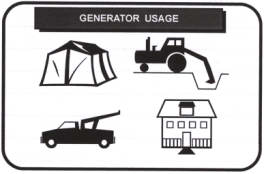
Generators are used to perform a wide variety of chores. The wide variety of generators meet the demands of the variety of almost all potential users. Generators offered by GeneratorJoe provide a high quality power source that is reliable and convenient to use.
| Generator Usage
|

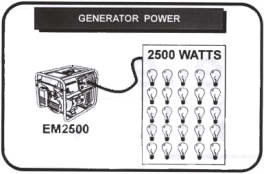
| GENERATOR POWER Most generators produce AC voltage, very similar to the voltage available in your home. The amount of power that a generator can produce is rated in watts (power). For Example, an EM2500 generator produces a MAXIMUM 2500 watts of power. This means the EM2500 could provide power to 25 one hundred watt light bulbs at the same time. The generator would then be at its MAXIMUM power output. | |||||
| Generator Power
| ||||
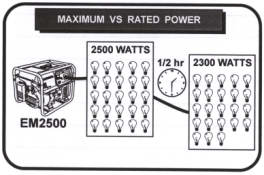
| MAXIMUM AND RATED POWER A generator should never be operated at its MAXIMUM power output for more than 30 minutes. RATED power is a more reliable measure of generator power. It is the power that a generator can produce for long periods of time. Typically the RATED power is 90% of the MAXIMUM power. | |||||||
| Rated and Maximum
| ||||||
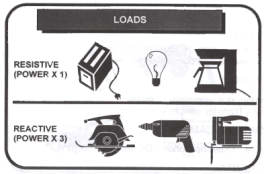
| LOADS In the previous example, the light bulbs are the LOAD of the generator. The EM2500 generator can handle a LOAD of no more than 2500 watts maximum. The light bulb example is called a RESISTIVE type load and the POWER it requires is pretty easy to understand. Other RESISTIVE types of LOAD are things like toasters, convection ovens, hot plates, curling irons, coffee makers, stereos and TV's. RESISTIVE LOADS are usually those that do not have electric motors. Another load is the REACTIVE type and is a little more confusing. Typically, a REACTIVE load contains an electric motor. This type of load may require up to three times as much power (wattage) to START as it does to keep it running. Examples of REACTIVE type loads are air conditioners, refrigerators / freezers, furnace fans, well pumps, bench grinders and air compressors. | |||||
| Loads
| ||||
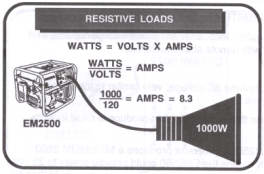
| RESISTIVE LOADS The equation shows the relationship between watts, volts and amps in a PURELY RESISTIVE load. If you know any of the two variables, the third can be calculated. Example: You want a generator to power a 1000 watt flood light. The light is 120V and requires 1000 watts of power. Using the equation, we can calculate that the floodlight will draw 8.3 amps of electrical current. For REACTIVE loads, the equation shows only a general relationship between watts, volts and amps. That's because the power requirements for REACTIVE loads changes with operating conditions. | |||
| Resistive Loads
| ||
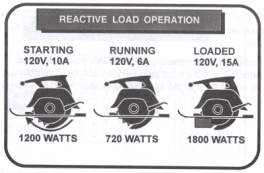
| REACTIVE LOADS When determining the proper generator for REACTIVE type loads, you must consider three modes of operation:
| |||||||
 | Reactive Loads
| ||||||
| LOAD POWER REQUIREMENTS Here are a few ways to determine power requirements for various loads that are expected to be powered by a typical generator. Method 1, using estimating charts, can be used to get a general idea of the generator size. Method 2, reading the motor data tag, is more accurate since the data tag information is provided by the motor manufacturer. Data tag information does not always show STARTING power requirements for REACTIVE type loads. See "CODE CHART" at the end of this page. *Note: Data tag information can usually be found in the owners / operating manual as well. | |||||
 | Determine Load Requirements
| ||||
| ESTIMATING CHART Method 1 requires using the load wattage estimating chart. It gives two figures of watts needed to power various loads; Running and starting watts. Add up all of the watts estimated for the loads / appliances / tools that you want to operate at the same time. If the load is a reactive type, use the STARTING WATTS for your estimation. Select a generator that is as large or larger than the total number estimated. Example: If you only want to run a refrigerator (2200 starting watts) and (2) 100 watt light bulbs (200 watts) - You would need a 2500 watt generator. | |||||||||
 | Wattage Estimating Chart
| ||||||||
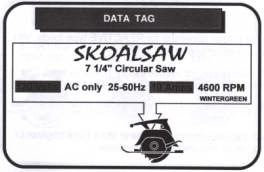
| DATA TAG Method 2 requires a visual inspection of the data tag supplied by the electric motor manufacturer. All electrical motors have a data tag attached to their bodies that give volts, amps, phase, cycles, hp, and sometimes a code. Volts (V) - The volts must be either 120 (110-120) or 120/240. 120/240 means that the motor can be wired to operate on 120V or 240V. Typical generators are either 120V or 120/240V. Amps (A) - Indicates the amps required to RUN the electric motor but doesn't consider STARTING or LOADED power requirements. Phase (PH) - The most commonly used generators can power only single phase motors only. Horsepower (HP) - Rating of how much work an electric motor can perform. Code - This isn't always supplied on the data tag. It represents the maximum STARTING power required of the electric motor. Cycles (Hz) - All of U.S. electric appliances run at 60 cycles per second. | |||||||||||||
 | Read the Motor Mfg. Tag
| ||||||||||||
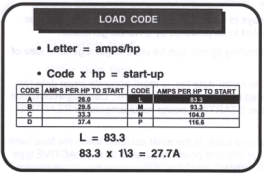
| LOAD CODE Example: The data tag on our electric motor shows a code of L. Our motor is 1/3 Hp. An L code is 84 amps per Hp x 1/3 (motor Hp) = 28 amps to start the motor shown.
| |||||||||||||||||||||||||||||||||||||||||
 | Load Code
| ||||||||||||||||||||||||||||||||||||||||