Frequently Asked Generator Questions
Q1. How large a generator do I need for my home or small business? Your service panel is normally rated at 200 amps @ 240 volts and the average home uses approximately 140 to 160 amps of 240 volts power to operate everything at the same time. Your larger appliances (well pump, kitchen stove, water heater, electric dryer, electric heater and heat pump system) will typically use 240 volts power and the lights and other smaller appliances will use 120 volt power. It is important to consider this difference in doing the load calculations because the important calculation is to determine just how many amps and watts you will need. For example, if you want to operate your refrigerator (20 amps x 120 volts = 2400 watts), freezer (20 amps x 120 volts = 2400 watts), electric hot water heater (20 amps x 240 volts = 4800 watts), washer (20 amps x 120 volts = 2,400 watts) and electric dryer (30 amps x 240 volts = 7200 watts) all at the same time you will need approximately 19,200 watts to meet the breaker requirements for these appliances. In reality the breakers are typically oversized for safety by 10 to 15% and the above appliances will not all operate at peak at the same time and the above load can be handled with a 15,000 watt (15 kW) generator set (GenSet). The major appliances, pumps, or other motor driven devices that you plan to operate with your generator system need to be considered when calculating the minimum size of a generator. Sizing a generator system requires you to honestly assess your needs and wants. Generally you can cut through all this stuff with these simple rules. If you have 100 Amp service panel, use a 8-12 kW GenSet (use larger if you have air conditioning). If you have a 200 Amp service panel, use a 15-20 kW GenSet (again use the larger size if you have air conditioning or large well pump). If you have a 400 amp service panel, use a 30-50 kW GenSet (if you have lots of air conditioning or other larger loads use the large size in the range). There are some other power requirements that will help you establish a minimum size generator system:
A. Every home or small business is different. The size of the generator is based on the type of appliances, equipment, pumps, air-conditioners and other electrical devices requiring power.
1) Well pumps usually require 2-3 times the run watts to start the pump.
2) Combination heat pump/air-conditioner systems are normally on 60 amp (14400 watts) breakers and use 30 amps (7200 watts) for the heat cycle and the same for the air-conditioning function.
3) Electric furnaces are typically on 50 amp breaker. (6,000 watts at 120 volts)
4) Hot water heaters normally use between 20 amps (4,500 watts) and 25 amps (6,000 watts) depending on the size and efficiency design
5) Electric kitchen stoves are usually on 50 amp (6,000 watts) breakers.
6) Air-conditioners come in a variety of sizes and ratings which need to be calculated based on the BTU output. A 2-ton unit is rated at 24,000 BTU's 20 amps (5000 watts) to start the unit and 15 amps (3,600 watts) to operate it.
A. GeneratorJoe supplies many of the best generator products available in the world today at the most competitive prices available. Our factory direct program removes the middle man and generally saves the customer 10-30% off the normal dealer price. Retail stores are usually restricted to one brand. We have a wide selection of products so you get the best model for your application at the best possible price. GeneratorJoe gives you the selection and services needed to make it easier to own a generator system.
GeneratorJoe provides:
Sales: Competent and knowledgeable salespeople to discuss all your requirements and application and to properly size and calculate all motor starting requirements.
Customer Service: parts and warranty assistance on all products purchased from GeneratorJoe.
Technical Support: trouble-shooting service via phone, fax, or e-mail. Shipping to your door or export freight forwarder
Products: We have the best products on the market at the best Prices. We don't sell junk equipment, cheap imports, cheap hardware store brands or low price volume products that most generator companies wont sell. If we sell it, its quality.
Q3. Single or Three Phase? Is a 3-phase generator suitable for the average homeowner or small business?
A. Yes and No. Some manufacturers use an over-sized 12-wire 3-phase generator end for single-phase applications. This allows the generator system to be used for both single-phase and 3-phase applications. The advantage of using an over-sized generator in a 3-phase or single-phase application is to meet motor starting requirements without having to use an overly large diesel engine. For most residential applications are 1 phase (single phase) and using a 3 phase generator is a waste of money and fuel. If you have a 3 phase service you will need a 3 phase generator otherwise use a unit built as single phase. Be cautious, some dealers will try to sell you a 3 phase generator "strapped" for single phase. You will lose 30% of the generators output and use 30% more fuel to make single phase power.
If your generator system will power air-conditioning units, pumps, heat pumps, well pumps, welders, or irrigation pumps you need assistance calculating your service size let us know. We will make sure you get the right size. GeneratorJoe provides this service free. We will insure that the when your generator is built that the voltage is set and the GenSet is tested at the factory before shipment.
Q4. What is the function of the electronic controller on a GenSet?
A. Most of the engine/generator controllers used today are digital and are designed to provide control of the generator set. (GenSet). The controller system monitors the operation of the engine and generator functions. Typical safety items include low oil pressure, high temperature, engine start over-crank, over/under frequency (speed), low coolant level etc. Modern digital controllers for residential or small business applications are typically a simplified LED indicators a start-stop button with or without auto-start. If the generator has auto-start, the controller can be used to interface with an automatic transfer switch or inverter/battery system to start and stop automatically. Usually manual controls are provided on al generators including those with auto-start. Advanced controllers provides real time monitoring of volts, hertz and amperage in addition to the basic engine/generator safeties and auto-start functions. Complex controllers typically installed on larger generator systems provide engine safeties and shutdowns for low oil pressure, high temperature, engine start over-crank, over/under-speed, low coolant level and also have indicators for low fuel level, KVA output, KW output, power factor (PF), engine & generator gauges in real time. Larger generators often have a communication capability for remote monitoring and starting.
Q5. Can I use a portable generator for an automatic starting system?
A. Generally No. Most portable generators do NOT have the capability to auto-start. The generator must have an electric starter, electric choke (for gasoline units) and the start and stop controls and safety sensors to be able to start and stop automatically. The cost of auto-start and safety equipment generally increases the price of portable equipment so much that no one would buy them, so they are not manufactured.
Q6. What kind of generator should I purchase - gaseous or diesel?
A. There are a number of factors to consider in evaluating the differences between a gaseous (natural gas or propane) powered engine.
See our Generator Fuel
chart for a list of positive and negative factors of fuel and generator types.GeneratorJoe recommends the use of liquid-cooled diesel engine GenSets in hurricane environments where the potential for long run times is high or for prime duty applications where the generator is the prime source of power. GeneratorJoe carries a number of high quality diesel powered generator products designed to provide years of trouble-free operation.
Q7. Do 3600 RPM diesel generators last as long as 1800 RPM GenSets?
A. Generally the 1800 RPM engine speed will out last the 3600 RPM units. Most small diesel portable generators in the 3 kW to 6 kW class are air-cooled 3600 RPM engines are designed to keep the weight and cost down. Generally air cooled GenSets are for temporary use and have short lives. If you need a long term solution or have several outages a year or long outage times use a liquid cooled 1800 RPM GenSet.
Q8. We want the power generator to supply power to a computer system in our home or business; what are the issues involved?
A. Most generators sold by GeneratorJoe are designed to power computers. The majority of 1800 RPM and 3600 RPM liquid-cooled generators use automatic voltage regulated (AVR-Electronic module) generator systems that provide from 1% to 2% voltage regulation, which meets or exceeds the local utility power specifications. Some portable generators with capacitor regulation (voltage control from 5% to 10% or without AVR) can present a problem for some computer systems if the computer is plugged directly into the electrical circuit and does not use a battery regulated power supply or UPS. Another factor that impacts computers is the speed control, (which effects frequency in hertz) which is normally 3-5% with an engine mechanical governor regulation and .25% to .5% regulation with an electronic engine governor system. Mechanically governed systems are normally sufficient to provide clean power for sensitive electronics like computers. For computer service centers and other communication applications like radio and TV stations that use a UPS system, they usually use of an electronic governor. Electronic governors not only maintain engine speed more accurately but with a much quicker response time to no-load to load conditions which helps prevent voltage drop. Most industrial diesel engines equipped with auto-start can be equipped from the factory with an electronic governor depending on the manufacture and engine design, however the costs will be much higher than a mechanical governor and may not be necessary for most uses. GeneratorJoe has developed a series of Cummins diesel powered open and sound enclosed GenSets rated for both standby (emergency service less than 500 hours per year) or prime (main power source over 500 hours per year). The new GeneratorJoe Cummins powered Warrior and Gladiator Series represents one of the most competitively priced full featured quality diesel generators on the market today.
Q9. What does the term "Wet Stacking" mean in a diesel engine?
A. Diesel engines are designed to operate with a load. When a diesel engine operates considerably below the rated output level the engine can start to over-fuel or "Wet Stack". Diesel engines perform most efficiently in the 70-80% range of rated output. When an engine operates for a prolonged period of time below 40% of the rated output it begins to over-fuel. This is similar to driving a car in the City at slow speeds for long periods. Wet Stacking occurs because the injection tips began to carbonize and disrupt the fuel spray pattern. Commercial generator systems often have widely varying loads with some low output conditions often have wet stacking problems because of the diverse load applications and owners artificially load the generator with an automatic load bank. A load bank will place a "false" load on the generator system to keep the diesel engine properly loaded. Once a diesel engine begins to "wet stack" the only way to correct the problem is to load the engine for a couple of hours to burn off the excess fuel and clean up the engine. This is seldom necessary in a residential or commercial application. Generally, electronically controlled engines and engines with advanced emission systems are less likely to "wet stack". It is for this reason that proper sizing and design is important. GeneratorJoe can help you with all your sizing and design considerations.
Q10. What kind of maintenance will my diesel generator need and how complicated is it for the average homeowner or small business?
A. Diesel engines require routine maintenance for long-life service. The normal maintenance requirements are about the same as owning a diesel powered vehicle - oil, oil filter, air filter and fuel filter. In tropical and cold climates it is advisable to have a water-fuel separation filter system installed. Water or moisture in diesel fuel can be damaging to a diesel engine because the water properties create advanced ignition and accelerated detonation.
The engine will need an oil change every 250 to 500 hours depending on the dust conditions or annually in the case of standby generators. Change the oil filter when you change the oil. Air filters need to be changed when they appear dirty. Check air filters whenever you inspect the generator or change the oil. Fuel filters are normally changed every 250 to 300 hours depending on how clean the fuel is. Inspect fuel filters when you fill the tanks, during oil changes and any time you inspect the generator. If the generator has a service schedule, follow it.
The generator end (AC alternator) will not require any service unless you live in a dusty environment. In dusty environments we recommend you use a high pressure (50 PSI) air hose and occasionally blow out the dust from the generator system. Dirt and heavy dust particles can cause shorts in the internal wiring coatings under the right conditions.Q11. Will the GenSet I purchase from GeneratorJoe have adequate operating instructions and service manuals?
A. Every GenSet sold by GeneratorJoe comes complete with an operators manual for the engine, generator and controller if applicable. We will include any special instructions for added options or features, if available. Some manufactures offer factory service and parts manual kits as an option.
Q12. How do transfer switches work and can I install one myself? For manual switches. The normal sequence of events to transfer a manual switch when the power goes off, follow these simple steps. 1) Leave the transfer switch in the utility position. 2) Start the generator and allow it to properly warm up. The generator breaker should be in and stay in the on position; 3) Once the generator engine is warmed up move the transfer switch to the generator position. When the power returns from the utility the sequence of events is reversed: 1) Simply move the transfer switch to the utility position 2) After the generator engine has run with no-load and cooled down for approximately 5-minutes shut the generator engine down. Q13. What is the difference between standby/emergency/maximum and prime/continuous duty applications? Q14. Why do well pumps, air-conditioners, welders and other electrical motor driven appliances require special consideration when sizing a generator? Q16. What are the most important things to consider when purchasing a standby/emergency generator system? 1) A generator is a major purchase and should be amortized over it's expected life. A generator can last 10 to 20 years if properly taken care of. For most residential applications a quality generator will last a life time if used for standby/emergency backup. For this reason we recommend the purchase of a quality GenSet with suitable features for your application. A cheap or bargain price will become an expensive lesson when your buying the second or third generator or when the power goes out and the cheap unit fails. Buy right the first time, spend a little more on quality. Don't be cheap at first and spend more in the long run. 2) If your backup requirements are "occasional" and you only need limited power during an outage an inexpensive generator system will most likely meet your needs (air-cooled, 3600 RPM gasoline, diesel or gaseous GenSets will work. 3) If you live anywhere on the East Coast, Florida, or in the Caribbean you are likely to need a heavy duty diesel GenSet and one with high quality features. Most modern gaseous or diesel engines are reliable and fuel efficient. Block heated diesel models provide easy starting in cold weather. An 1800 RPM, liquid cooled generator will provide better fuel efficiency and longer life but cost more initially. 4) The generator end is the usually the last thing to fail with heavy use. The insulation coatings on the windings are based on heat ratings and 'F' is good and 'H' is better. Some major brands manufacture their own generator ends and parts and repair is usually only available through the manufacturer. Most manufacturers use off-the-shelf industrial brands like Marathon, MeccAlte, Newage and Somers because parts are readily available and any qualified service repair center can service the generator end. 5) Controllers are a vital part of most generator systems. The controller monitors the generator engine speed for hertz, the oil pressure and water temperature and other engine and generator functions. It shuts down the engine if one of the threshold settings for these controls fails. It also provides the auto-start function for the automatic transfer switch or inverter if one is used. Buy a unit with adequate controls. Don't buy glitz and features you do not need, just more things to take care of and go wrong. All GeneratorJoe models come with digital control panels. 6) A generator is a mechanical and electrical device that over time will need some service or parts. Make sure you are purchasing a generator system that will be supported in the future from a company that will be there to support you. Someone reliable brands like GeneratorJoe or Winco are best. 7) Know what you intend to run with your generator and make sure the generator you purchase will handle your load. GeneratorJoe can help you with design considerations, load calculations and motor starting considerations. Q17. Where Do I find transfer switches? Q18. What size transfer switch do I need? Q20. Can I save money buying a manual transfer switch? Q21. Do I need an indoor (Nema1) or outdoor (Nema 3) switch. Q22. Do you have RV transfer switches? Q23. Is there a way to get a competitive price on a number of different transfer switches? Q24. Where are the prices on products? Q25. Where are the prices on options or product accessories? Q26. How do I find a generator model I want? Q27. What size generator do I need? Your service panel is normally rated at 200 amps @ 240 volts and the average home uses approximately 140 to 160 amps of 240 volts power to operate everything at the same time. Your larger appliances (well pump, kitchen stove, water heater, electric dryer, electric heater and heat pump system) will typically use 240 volts power and the lights and other smaller appliances will use 120 volt power. It is important to consider this difference in doing the load calculations because the important calculation is to determine just how many amps and watts you will need. For example, if you want to operate your refrigerator (20 amps x 120 volts = 2400 watts), freezer (20 amps x 120 volts = 2400 watts), electric hot water heater (20 amps x 240 volts = 4800 watts), washer (20 amps x 120 volts = 2,400 watts) and electric dryer (30 amps x 240 volts = 7200 watts) all at the same time you will need approximately 19,200 watts to meet the breaker requirements for these appliances. In reality the breakers are typically oversized for safety by 10 to 15% and the above appliances will not all operate at peak at the same time and the above load can be handled with a 15,000 watt (15 kW) generator set (GenSet). Generally you can cut through all this stuff with these simple rules. If you have 100 Amp service panel, use a 8-12 kW GenSet (use larger if you have air conditioning). If your have a 200 Amp service panel, use a 15-20 kW GenSet (again use the larger size if you have air conditioning or large well pump). If you have a 400 amp service panel, use a 30-50 kW GenSet (if you have lots of air conditioning or other larger loads use the large size in the range). Q28. Can I sell generators for GeneratorJoe? Q29. Does GeneratorJoe have discounts for multiple generator purchases? Q30. Does GeneratorJoe sell used generators? Q31. Does GeneratorJoe provide credit for purchases? Q32. Does GeneratorJoe provide financing? Q33. Does GeneratorJoe have a store? Q34. Does GeneratorJoe have a catalog? Q35. What is GeneratorJoe's email address? Q36. Does GeneratorJoe sell parts? Q37. How many electric plugs does a generator have? Q38. What fuel should I use in my generator? Q39. Q40. Is there sales tax? Q41. Do I need a fuel tank? Q42. How do I pay? Q43. Q44. Q45. Q46. Q47. How do I find a freight forwarder? Q48. How do I find a electrician? Q49. Does GeneratorJoe ship COD? Q50. What is included with each generator? Q51. Does this generator come in 50 hertz? Q52. Q53. Q54. Q55. What does the warranty cover? Q56. How are warranties handled by GeneratorJoe? Q57. Q58. How much is the shipping? Q59. What do accessories cost? Q60. What are the dimensions and weight of a generator? Another source of dimensions and weight is the factory brochure for the product. Click on Q61. Can I get wheels for a generator? Q62. How can I compare generators? Q63. What voltage and frequency is used in other countries? Q64. Where are power plants in the world located? Q65. Does GeneratorJoe have a privacy policy? Q66. Where are the policies and procedures that govern GeneratorJoe sales? Q67. How can I find Government grants go by generators and transfer switches? Q68. Does GeneratorJoe have customer references? Q69. How can I leave feedback for GeneratorJoe? Q70. Does GeneratorJoe link to other sites? Q71. How does GeneratorJoe compare to the competition? Q72. There are buttons all over the GeneratorJoe website, what do the do? Call us for a generator consultation and questions. We are here to help. About Generators - About Transfer Switches - Tables and Formulas - Glossary - Help Index
A. GeneratorJoe recommends that transfer switches be installed by a licensed electrician. A transfer switch is a box that only allows power to be supplied to the distribution panel from the utility or the generator system, but not both at the same time.
There are basically three types of transfer switches to consider.
1) Manually operated panels providing 6 to 10 pre-selected circuits that can be used during any generator supplied power situation. These types are used primarily for portable generators. You can find several brands on the internet.
2) Manually operated Service rated (e.g. 100A, 200A, or 400A) NEMA-1(indoor rated) or NEMA-3R (outdoor rated), UL rated panels for either single or 3-phase applications. See ASCO Manual Light Duty Switches and ASCO Manual Switches.
3) Automatic operated Service rated panels. See ASCO Automatic Transfer Switches.
To read about how a transfer switch works go to What About Transfer Switches.
Automatic switches do all the functions needed to go from utility to generator power and back, without any intervention by a person. If you are often away from home working, leaving your spouse and kids at home alone, use an automatic system. You don't want them going outside and trying to transfer equipment they are not familiar with. Automatic systems also exercise the generator every month to circulate oil and charge the batteries.
Three phase systems should always use automatic transfer switches because they include in-phase monitoring controls that prevent power transfers when the transfer will damage a out-of-phase equipment.
A. Most products have a "maximum" rating, also called standby and emergency rating. This value is the most that a generator can produce under normal conditions although it may still have some peak reserve for surges. The prime or continuous rating is the rating that the equipment should not exceed under normal running on a continuous basis. Even though small portables have both ratings that does not mean that they are designed for continuous use. A prime power generator must be 1800 RPM and liquid cooled. Any air cooled or 3600 RPM generator is a standby generator no matter what other dealers may tell you. Most residential generators are standby rated. You should use a prime rated, 1800 RPM, liquid cooled generator when the number of hours per year will exceed 500 and the use is on a regular basis. If you start the generator many times a year for short periods you may also need a prime power rated generator. You must use a prime power rated generator when the generator is used 24 hours per day and 7-days per week. If you use a standby generator in a prime power situation the generators life expectancy can be shortened considerably and the potential for premature failure is increased dramatically. Buying a GenSet rated for standby duty and using it for prime or prime continuous application is just dumb and will normally void your factory warranty as well. Your generator system should be considered a long-term investment and should be sized and selected properly.
A. Appliances and equipment with electric motors, especially compressors and well pumps, have a much higher start up amperage called Locked Rotor Amps (LRA), than the running amps shown on most nameplates. As a general rule of thumb is a minimum of at least twice the amperage to start a device as to run it. However, some devices can require up to 6 or 7 times the amperage to start as to run. If you have water wells, large air-conditioners, sump-pumps, or other heavy duty motor applications you need to find out what the locked rotor amps of the largest piece of equipment is. GeneratorJoe can assist you with all of your motor starting calculations and we can supply you with generator systems designed to provide the best performance and size for heavy duty motor starting applications.
Q15. How are decibel levels calculated on generators?
A. Most generator manufactures, but not all, calculate dBA levels at full load operation. The USA standard is based on the sound level at 21 feet (7 meters) and the European standard is based on the sound level at 23 feet but its close enough to compare. The calculation of dBA levels involves a complicated mathematical formula. The relative noise level is the best way to understand the relationship of one sound to another. Human conversation is 60 dBA. below are typical descriptions of sound levels. Take all sound levels provided by manufactures with a grain of salt. You cant tell the difference in 5 dBA without a lot of experience and a sound meter. See our noise table on the NOISE index.
Industrial Quiet well designed enclosure with air-scoop and dense foam. 69 to 75 dBA - noticeable noise level at 10-feet / loud conversation at 21-feet.
Residential Quiet well designed enclosure with air-scoops and foam. 64 to 68 dBA - quiet but noticeable at 10-feet / normal conversation at 21-feet.
Super Quiet special sound attenuation enclosure normally with air-scoops and dense foam. 61 to 63 dBA - normal conversation at 10-feet / quiet operation at 21-feet.
Ultra Quiet special sound attenuation design for rental fleets or residential applications. 56 to 60 dBA - barely hear the unit operate at 10-feet / normal conversation at 10-feet.
Entertainment Industry Quiet Special and expensive sound attenuated and designed GenSets. 50 to 55 dBA - barely hear the unit operate at 3-feet / normal conversation next to GenSet.
For the average residential application, the residential levels shown about are adequate. Some engines tend to be noisier than others and will have some effect on the overall dBA rating of the unit. Obviously, a 10 kW generator is typically quieter than a 40 kW if all other conditions are equal. The abatement of noise in all GenSets is normally a function of the enclosure design, air-flow and the quality and type of insulation used. Front air-scoops are typically used to remove radiator sound. Special residential grade muffler systems are used to help reduce the engine noise.
A. Here is a list of important things to consider.
A. Go to the transfer switch page and select a category. Click on this link. Transfer Switches.
A. The transfer switch is sized to match the service or sub-panel on the building. The transfer switch must also be the same size in amps (or larger) than the
A. The automatic transfer switch monitors utility and generator power. When utility power fails or is unsatisfactory, the transfer switch control starts the generator set, checks the generator speed and voltage output and transfers the load to the generator set. When utility power is restored the transfer switch automatically transfers back to utility power. The generator is allowed to cool down for a short period and then shuts down. The system instantly resets itself and is ready for the next power interruption. No action is required by the user.
A. Generally no. Most modern automatic transfer switches have a manual mode so they do not switch until you change the switch position to transfer or automatic. New switches are electrically operated and when they change position they use power from the utility or generator to move. They DO NOT have handles on the sides of them like old fashioned switches. You may save $100 or so on a manual switch and you cannot retrofit the switch later to make it automatic. For portable generators buy a manual switch from Reliance Controls. We carry a full line of automatic and manual switches.
A. If you can install the switch inside a building you can use an indoor switch. Inside means in a heated garage or building. An unheated, drafty, damp tool shed is considered outside. In most cases it cost a few dollars to a few hundred dollars to upgrade to an outdoor Nema 3R switch. We always recommend that you buy an outdoor switch because they are water resistant and tighter than indoor switches. If there is any chance water will be sprayed around a transfer switch, an outdoor version is always a good investment. Any moisture inside a transfer switch will cause it to fail at the very time you need it.
A. Yes we do. Go to the transfer switch page and select the RV transfer switch category. Click on this link. RV Transfer Switches. Then click on RV transfer switches.
A. Yes. At the top of every page there is a button that called Transfer Switch Find. It looks like this. > Find a Transfer Switch
There are also buttons like this on every product page on the website. You can go to the finder anytime, even if you have items in the shopping cart.
A.
A. Some products, like transfer switches, will not have a basic price. To see the price on a switch you must select the switch and sometimes an enclosure from the yellow options bars, below the price bar. If you put you mouse on the options bars, the bar will drop down and show you the switches and their prices. If you select a switch, the price of the switch will automatically appear below the Our Price label. You can remove the switch product by clicking on its window and selecting the yellow header.
A. There are several ways. On the left side of any page is a blue column. Scroll down the column until you find Search  . Type in the model number and click go. If you don't find it at first try changing the model with spaces. If that does not find you want you want, click on Advanced Search or on the Find a Generator button, located on every product page and on the masthead of every page.
A. We do not have a dealership program. Most manufacturers prohibit us for establishing dealers. You can buy our products and resell them by adding to the price you paid.
A. We do have discounts for multiple generators but the discount is small because our prices are already very competitive.
A. No, Current emissions laws do not allow the use of generators that do not have current emissions. Newer generators have very imporved emissions, safety features and fuel economy.
A. We only provide credit accounts to government agencies and educational institutions at our discretion. If we provided credit sales we would have to raise prices to cover the losses from such sales. We accept wire transfers, all major credit cards, company checks and money orders. All payments by checks, including cashiers checks and money orders must clear the bank before equipment is released. We also have lease purchasing.
A. We do have lease purchase financing up to $2,000,000 and 60 months. Click on the Lease to Own button on the top of every page or the 
A. No, we do not have a store. We are an internet company and we sell off of our website worldwide. If we had a store, our prices would be higher due to the higher overhead.
A. No, we don't have a catalog. Our website has extensive information and up-to-date-prices on every product. Companies that have catalogs have higher prices to cover the cost of the catalog and by the time they are printed they are out of date.
A. [email protected] Also see Contact Us
A.
A. To find out how many and what kinds of plugs a generator has go to the product page for the product and click on the
Detailed Specifications Tab. A window will fold down and show you the plug information. Industrial generators don't have plugs, they have "lugs". A lug is a set of screw down clamps that the power cables are connected to. You can have an electrician make you a plug panel for an industrial generator if you need one. Rental type generators, with 1 & 3 phase power usually have plug panels on them but they will not be shown in the specification window.
A. To see a discussion of the fuel types available for generators see About Generators and click on Generator Fuels. < You can click this link also.
A. To find out how fuel a generator used go to the product page for the product and click on the
Detailed Specifications Tab.. Sometimes these numbers are not totally accurate because they are estimated. To get the most accurate numbers, look in the  on each product page or click on the Factory Brochure link on the sub-category page for those products. For diesel generators see About Generators and click on Diesel Fuel Use Chart. < You can click this link also.
A. We collect sales taxes for all sales in California. We do not collect sales taxes for any other state.
A. Industrial diesel generators require a tank either under it (called a sub-base tank) or near it (called an external tank). We sell both types and they are listed as options in each generator product. RV generators require an external tank on the vehicle, we do not sell these tanks. Propane generators require an external propane tank, we do not sell these tanks. Portable generators have tanks installed on them and they are not expandable.
A. Click this link. How To Ship.
A. Click this link. How To Pay.
A. If we know the noise level of a generator, call dBA or decibels we will show that information on the product page. Find the product and click on
Detailed Specifications Tab. The information will be inside. You can also find the dBA rating in the on each product page or click on the Factory Brochure link on the sub-category page for that product. There is a noise table at Model Noise Specifications. Click on that link and you can see a noise chart that shows the relationship to everyday sounds. You can also look up specific models with the finder table and look up the value on the dBA column of that table.
A. The engine brand is shown on the sub-category page. (See the second line of the description), and on the product page for each product. Engines brand and model are shown on the product page Specification Window. Find the product and click on
Detailed
Specifications Tab. See Also Question 60 below.
A. Generally we require customers to hire a freight forwarder in the USA to receive their shipment and then re-ship it to the customers country. It is cheaper for the customer to make these arrangements. For shipments to Canada and Mexico we can arrange shipment through FedEx Freight. All taxes and customs are the responsibility of the customer.
A.
A. To find an electrician, use this website. Electrician Finder or look in the yellow pages of your telephone book under Electricians or Electrical Contractors.
A. We never ship COD.
A. At the bottom of each product description on the product page is RED text that describes what is included with each generator. It looks like this: Included Equipment: Generator engine and alternator, open skid mount platform, weather enclosure, no tank, flexible fuel lines, oil drain cock, digital control panel, electronic governor, residential muffler (enclosed models), industrial muffler (open models), spring isolators, 12 volt electric starter, included charging alternator, air filter, radiator, blower fan and guards, battery tray, battery cables, owners manual and warranty. Other options are NOT included please purchase the options from the option lists.
A. If a generator is available in 50 hertz it will have the 50 hertz ratings shown on the title line of the product and inside the product in the Specification Window. Find the product and click on
Detailed
Specifications Tab. See Question 60 below. Inside the window is all the amperages available for that generator. If it is available in 50 hertz a check box will show that says 50 hertz. If you check the box the 50 hertz values will be displayed.
A. Single phase has only one phase using two wires and three phase has three phases using three or four wires. Generally homes are single phase and business are three phase. If you go out to your main breaker panel you can usually tell if you have a single or three phase service. Single phase is 120/240 and three phase can be 120/240, 120/208 or 277/480. There are other voltages but these are the most common. If you are not sure what your power is, have an electrician come and look at your service or call your utility company.
A. No, we do not keep inventory. Everything we sell is drop shipped from the factory so you get the latest and most up to date model available. Most of our manufacturers do not permit public pick of products or pick up by carriers sent by the customer. There are many security and tracking reasons that we or the manufacturer will not allow pickup of products. We get the best freight rates in the industry and we can ship it to you cheaper than you can arrange to have it shipped for. We track the shipment until it reaches you.
A. Most generators have a 12 month warranty. GeneratorJoe brand industrial and marine generators have a 5 year, 5,000 hour warranty, the best in the industry. Look on the product page for the product you are interested in and there will be a warranty statement telling you how long the warranty is.
A. On the generator product page you can find a warranty button 
A. GeneratorJoe tries to sell the highest quality products available. The factory warranty including the warranty terms & conditions on products are published on our website and we will help you get warranty service from the factory.
It is the customers responsibility to get the product back to the manufacturers warranty station or factory for any warranty support. Larger units are serviced in the field by the manufacturers service organization or by qualified dealers. GeneratorJoe will try and make arrangements warranty work to be performed by a competent generator or engine repair facility near the customers residence or business. The quality of most generator products today is very high. The occasional problem can usually be resolved with a little trouble shooting and minor repair and this can often be done over the phone.
A. Some used generators have a warranty and if they do the warranty column on the New/Used Available now chart will say YES in the warranty column. You will have to email us about that products ID number to find out the warranty terms. Click on the items ID number and in the pop up window state you want warranty information on that product. Please do not ask for that information unless you are ready to purchase the generator.
A. Freight cost can be estimated by going into the product that you are interested in and looking for the Freight Quoter button. 
A. Some products, like transfer switches, will not have a basic price. To see the price on a switch you must select the switch and sometimes an enclosure from the yellow options bars, below the price bar. If you put you mouse on the options bars, the bar will drop down and show you the switches and their prices. If you select a switch, the price of the switch will automatically appear below the Our Price label. You can remove the switch product by clicking on its window and selecting the yellow header.
A. A quicker way to find basic information on a generator is to click on the Product Details on the sub-category page or  on the product page. You can also find out the dimensions and weight of a generator by going to the product page for the product and click on the
Detailed Specifications Tab. A window will fold down and show you the plug information.
on the product page. You can also find out the dimensions and weight of a generator by going to the product page for the product and click on the
Detailed Specifications Tab. A window will fold down and show you the plug information. 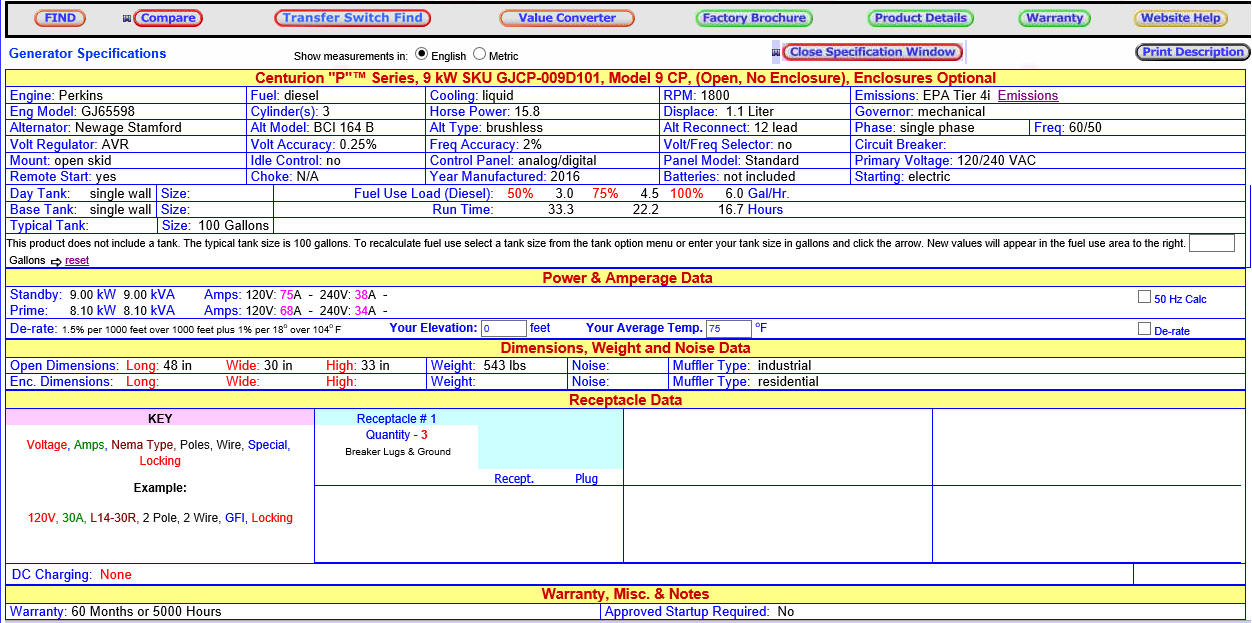 . If you want to find a generator of a certain weight or dimensions, click on
  on the product page or Find a Generator at the top of the website. Use the list maker to select a generator size, fuel and other info and then click go. A complete list of dimensions and weights is shown for the selected list. You can sort the list by the column by clicking on the column header.
A. If a portable generator has a wheel kit available it will show under the accessories or options for that product. Go to the product page for the product you are interested in and look for "wheel kits" in the yellow options boxes. If you put your mouse on the options bars, the bar will drop down and show you the options and their prices. If you select an option, the price of the product will automatically change to include the option price. You can remove the option by clicking on its window and selecting the yellow header.
A. On the sub-category page there is a button that says COMPARE  . If you click on this button it will add the generator to a compare list. You can click up to 5 generators to compare. As you add each generator a list will appear at the top of the page. The system wont allow you to add a generator more than once. You can remove generators by clicking remove on the compare list. when you are ready to compare click on on the compare list. A page will appear showing all the relevant information on each unit side by side. You can print the compare list on your printer. If you want to compare generators on printed paper forms you can go into each product and click on Product Details button or click Product Details on the sub-category page. When the page appears print it. Every generator except PTO and Two Bearing generators on the website has a Product Details page to print.
A. Go to World Electric Guide
A. Go to World Power Plants
A. Go to Privacy Policy
A. Go to General Policies
A. Go to Government Grants
A. We can only provide vendor references. Our privacy policy does not allow us to give customer information except for public companies. You can see names only at Our Customers
A. Go to Feedback
A. No
A. Go to GenJoe & the Competition on the top of the website or click on the button.
A. Go to on any product page to see a complete list of every button and link on the GeneratorJoe website.